The Missing Link
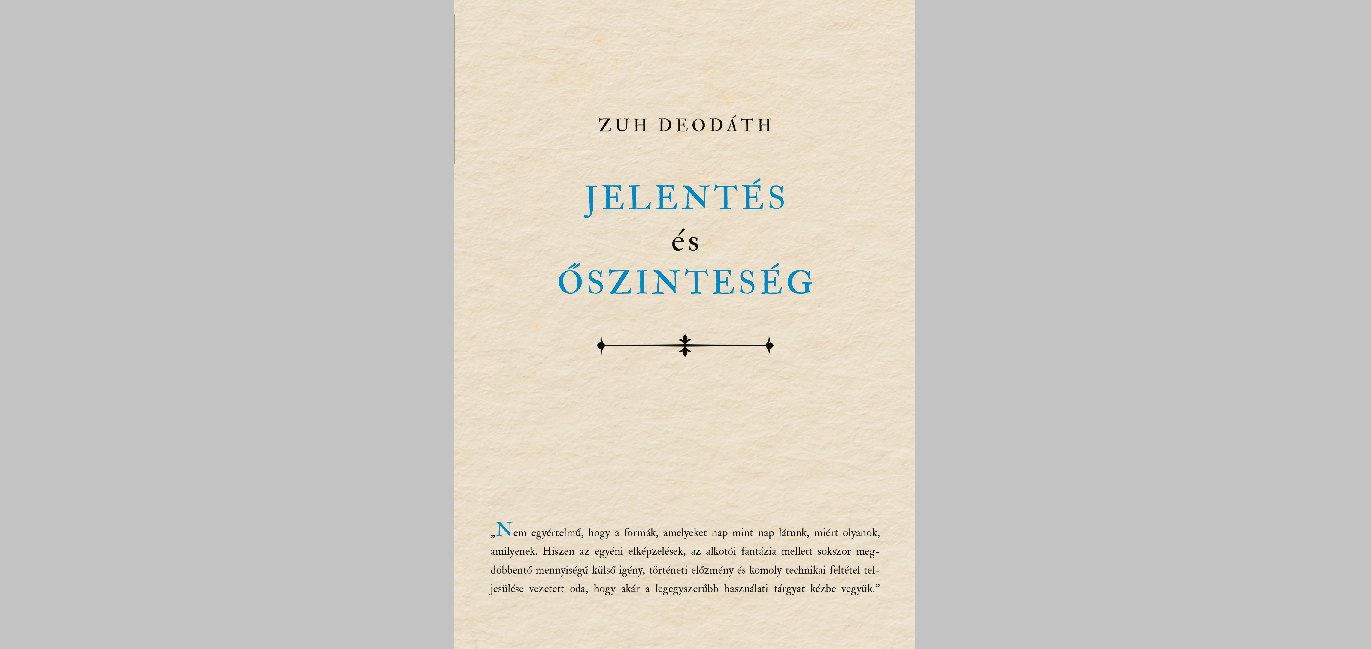
Deodáth Zuh: Meaning and Sincerity
Text: Rudolf Klein
Published by the Hungarian Academy of Arts Publishing House, this small-format, tastefully presented book is the young author’s eighth volume, in which he deals with the intangible components of architecture – meaning, aesthetics, architecture and its relationship with the public. The author introduces the reader to the depths of architectural semiotics and ornament theory, starting with rural houses, while pointing out interesting connections between old, familiar and ‘new vernacular’ architecture. From there, he moves to a higher level, focusing on the flat ceiling of Pompeii, the Crystal Palace, and the surface decorations of two synagogues, those on Rumbach Street and the Zion Temple in Oradea, Romania. From this ‘certain world’ we move on to the next chapter, where the author draws parallels between written text and the signs on buildings. To a certain extent, the most innovative part of the volume is related to meaning in the section on architectural history. This section goes far beyond socialist realism, its usual interpretation in the literature, and the general Sovietisation of Hungary. The book is clear and exciting all throughout, and its connections open up new perspectives in Hungarian-language architectural literature. Zuh Deodáth’s appearance on the Hungarian architectural scene seems to fill the role of the prematurely deceased Béla Kerékgyártó, who enriched the discipline, which mainly comprises architects and art historians, with his philosophical knowledge, broad erudition and ethos. A way of thinking based on philosophy has a refreshing effect on architectural theory, deepening and broadening it. The essence of Zuh Deodáth’s book is a semantic reinterpretation of the social role of architecture.