The “Hungarian Dolphin” Swims Again
HUN-REN Hungarian Research Network Headquarters, Budapest
Architects: Árpád Ferdinánd, Csaba Németh
Text: Tamás Ulrich
Photos: Miklós Bereszlényi
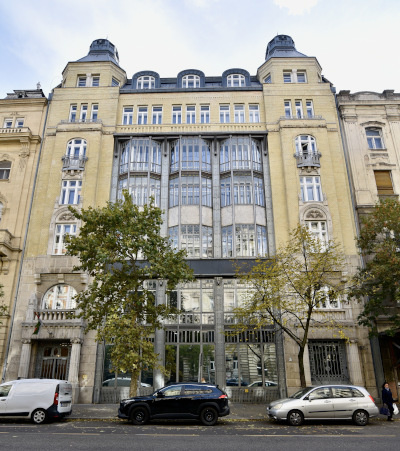
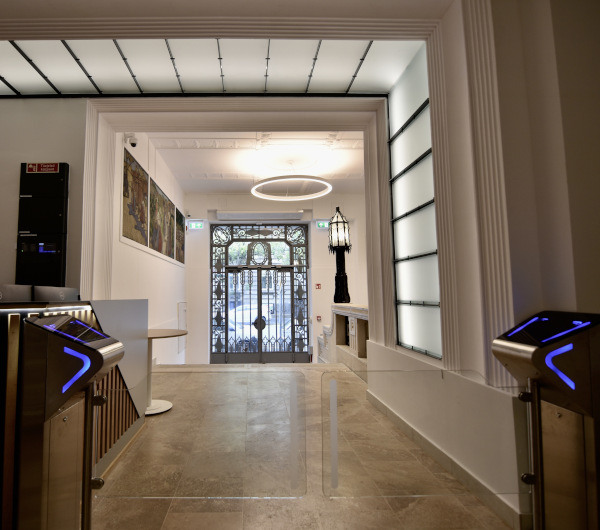
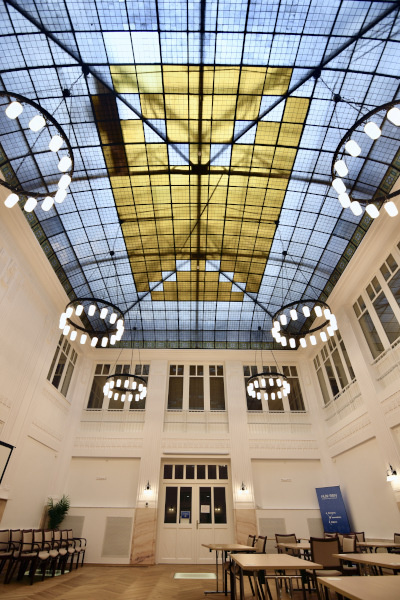
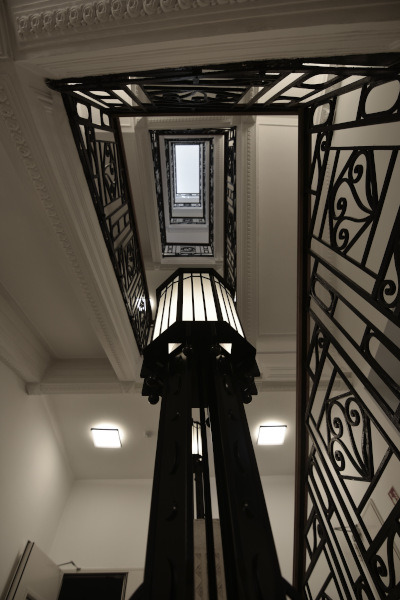
Launched in 2019, the Eötvös Loránd Research Network was tasked with maintaining, managing and operating research institutes and research sites separated from the Hungarian Academy of Sciences (MTA). From the summer of 2023 on, it will continue to operate under the name HUN-REN. Since March 2025, the network’s headquarters will be the building that was constructed between 1910 and 1912 according to the plans made by Alfréd Hajós and József Villányi for the Hungarian Farmers’ Cooperative. The former client, the Cooperative founded in 1891, was an organization representing the interests of aristocratic middle and large landowners, and the building thus reflected this level of demand and requirements. In the 1950s, it was used as the headquarters of the National Association of Cooperatives, and prior to its current renovation and modernization, it served as the office building of the Agricultural and Rural Development Agency. In 1911, Alfréd Hajós (architect and the first Hungarian Olympic champion, who won a gold medal in the 100-meter freestyle at the 1896 Athens Olympics and was dubbed as the “Hungarian dolphin” by the international press back in those days) and János Villányi designed the office building, which is still considered a modern one today, using new materials and modern technologies, with a five-story steel-framed glass wall on its street façade. The elaborate and sophisticated building was renovated to suit its new function and meet today’s requirements, whilst preserving its values. The original “curtain wall” façade overlooking the street has been completely preserved, and the design programme has retained the original layout of the building: a reception and exhibition space housed on the ground floor, a two-story ceremonial hall on the first floor, and offices above. The roof covering the representative two-story ceremonial hall on the first floor has been renovated, and the exterior covering converted into a thermally insulated glazed roof structure.
Phase 1:
Client: B+N Referencia
Architects: Árpád Ferdinánd – Ferdinánd és Ferdinánd Architects
HVAC: András Bokor – Vizaterv
Electrical engineering: György Kapitor – Zone-Plan
Structure: Levente Mihutz – MI.V Engineers
Fire protection: György Decsi – Fireeng
Kitchen technology: Katalin Harangi
Elevator: Ferenc Sütő, Balázs Kabai, Péter Barna – Schindler Hungária
Phase 2:
Client: Hungarian Research Network
General planning: Közbeszerzési és Ellátási Főigazgatóság (KEF)
Architect: Csaba Németh
Project management: Károly Faragó
HVAC: Csaba Rosza
Electrical engineering: Imre Jászfalui