A Monument to Absence
The Story of Disappearance, emory, and Urban Transformation at Pier 52
Text: Petra Probstner
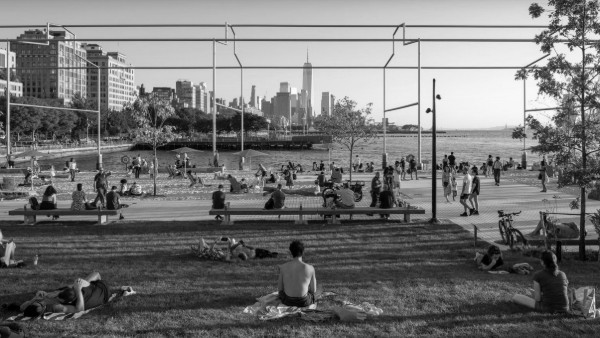
The steel structure that appears on the Hudson River waterfront in Manhattan’s Gansevoort Peninsula is visually a little more than a spatial line drawing: it has no walls, no roof, and, standing in the water, can only be viewed from the outside. Yet there is something monumental about it that makes you stop and raises questions about absence, the city, and memory. David Hammons’ installation, completed in 2021, is ostensibly a building, but in fact it is negative. The stainless steel lines redraw the silhouettes of Pier 52, demolished in 1979, indicating that the work is not a reconstruction but a frame that turns absence into the material of memory. Thus, this “non-building” gives spatial form to a missing chapter in the city’s history — as a symbol of a change in urban attitude, it rewrites collective memory and makes cultural content visible. Day’s End is not merely a public sculpture, but also a sort of spatial experiment that straddles the boundary between architecture and conceptual art. Hammons has created a kind of negative architecture here, where absence, space, and light become the building materials of the structure. The work depicts an invisible building — a frame in which nothingness takes on meaning, where erasure becomes the creation of forms. The silhouette does not show what is there, but what is no longer here — thus, paradoxically, destruction and remembrance become two manifestations of one and the same gesture. Hammons simultaneously evokes the reclaiming of nature, the disappearance of our industrial heritage, and the missing layers of social memory.